


Thursday, July 26, 2018
The CEEFIT sensor and the CEEFIT Pulse & ECG heart rate belt from Seaver measure the horse’s heart rate during training. Thanks to our scientifically tested electrodes, specifically designed for this purpose, Seaver’s connected devices provide real-time analysis of your horse’s heart rate with medical-grade accuracy. This is made possible in particular by the Seaver app available on smartwatches. These devices also allow you to receive reports on your horse’s heart rate progress after each session.
At rest, ahealthy adult horse has an average heart rate of 30 to 45 beats per minute. In foals, it can reach as high as 70. During exercise, the heart rate increases with gait and speed and can reach up to 240 beats per minute at the fastest gallop.¹ However, it should drop rapidly as the horse recovers.
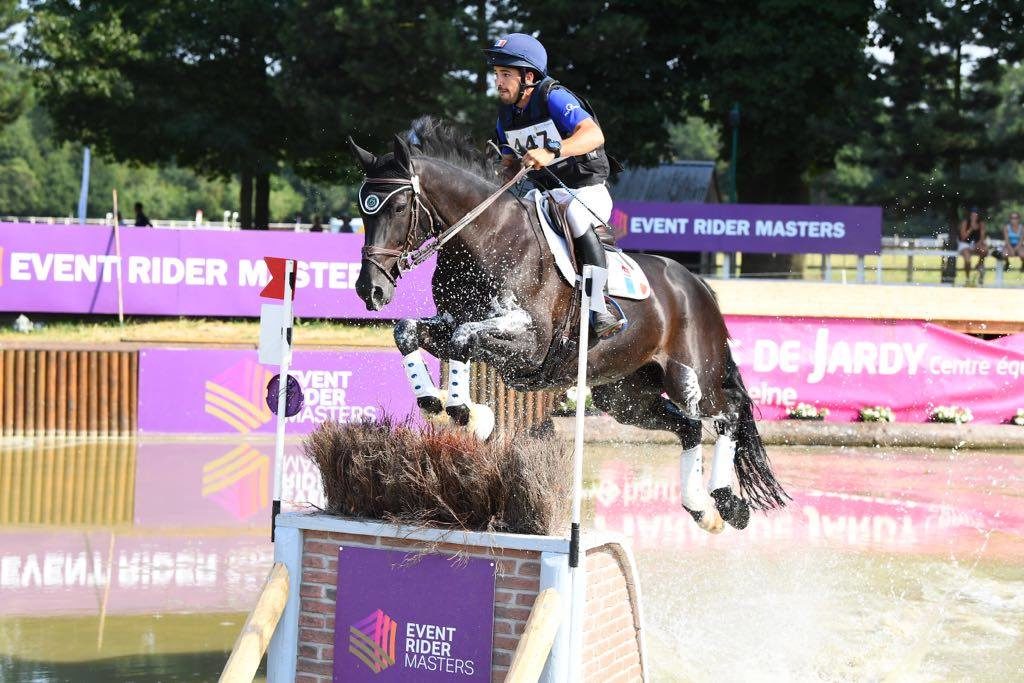
These figures should be adjusted based on the horse and the discipline. For example, an endurance horse will naturally have a lower resting heart rate. Several factors can also affect heart rate : excitement, stress, terrain, fatigue, the onset of lameness, or a systemic illness.
Monitoring your horse's heart rate during each training session will give you an overview of its overall health.
Heart rate is thethe ultimate indicator of the effort expended and its intensity. Knowing your horse’s exact heart rate therefore gives you a better idea of the intensity of the exercise being performed and helps you work on the horse’s physical conditioning.
When you view the home screen of your Seaver app (available for free right here), you can see your horse’s heart rate in real time—that is, the number of heartbeats per minute at a specific moment.
After the session, you'll have access to a detailed graph showing your heart rate over time during your last session. Different zones have been color-coded to help you ensure that you’re training your horse properly without compromising its health.
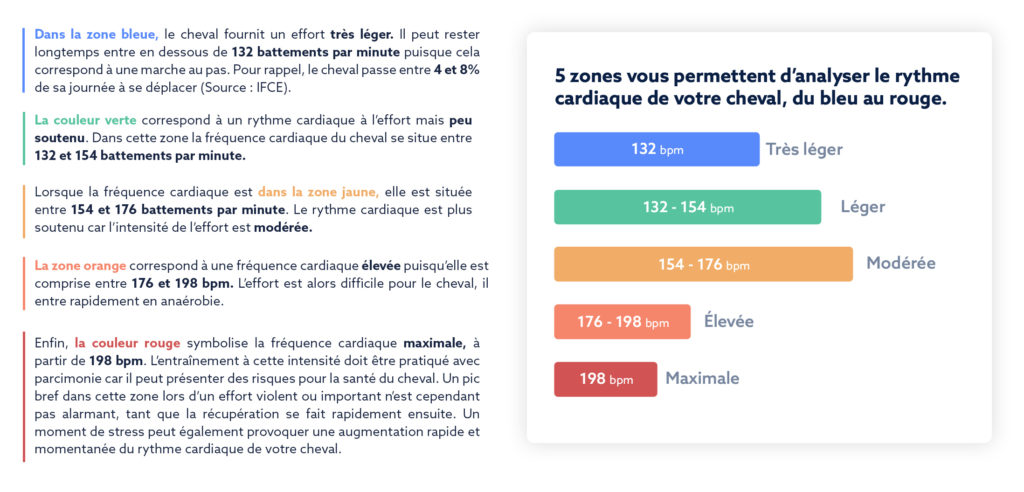
This data will help you ensure that you are training your horse sufficiently without overtraining it. Training that is too intense—pushing the horse too close to its limits—can lead to serious health problems that will be associated with a decline in performance. Conversely, training that is too low in intensity will not improve the horse’s health but can be important for promoting recovery. A good balance is the key to success.
In addition to tracking your horse’s beats per minute in the Heart Rate tab, Seaver provides a version that’s easier to analyze: exercise zones. Seaver distinguishes between times when your horse has simply burned calories (shown in blue and green) from the times during work when it has improved its cardiovascular fitness (in yellow and orange), and the times when it has worked at too high an intensity (in red).
The Your horse’s work leads to an increase in its energy expenditure compared to when it is at rest, which results primarily from muscle movement but also from increased activity in the respiratory and cardiovascular systems.
Knowing the horse's heart rate at all times allows us to calculate the energy expended and thus provide you with real-time data on calories burned.
According to studies conducted byINRA2, a healthy adult horse moving at a a trot at a speed of 18 km/h burns an average of 160 kcal/min. When the horse is galloping at a speed of 21 km/h, its energy expenditure is 210 kcal/min. These values, of course, vary depending on your horse (age, breed, sex) and the environment.
On the home screen, you can track the number of calories burned by your horse in real time—that is, the number of kilocalories burned since the start of your session. In the app’s more detailed tab, you’ll find the total number of calories burned during your workout, your horse’s average energy expenditure in kcal/min, and how that has changed over time. You’ll also see a percentage there. This is the app that calculates the intensity of the effort during your session based on a comprehensive analysis of your data.
By tracking the number of calories your horse burns over time, Seaver allows you to adjust its diet as needed.
During high-intensity physical activity, such as a long run, the workout is considered anaerobic. In other words, the oxygen demand exceeds what the blood can supply. This forces the body to use glycogen as its primary source of fuel. This glycogen is then converted into lactic acid. Lactic acid is partly responsible for muscle soreness in horses, just as it is in humans.
The buildup of lactic acid (>4 mmol/L) causes muscle pain and should therefore be avoided. To improve the elimination of lactic acid from the body, it is necessary to push your horse to its limits for a short period (between 30 seconds and 2 minutes). The heart rate during this time can reach up to 200 bpm.
Each workout should consist of between 2 and 8 intense intervals, depending on your fitness level. Allow sufficient recovery time between each interval. Your heart rate should drop to 100 bpm. It is recommended that you repeat this interval training onlyonce every 4 or 5 days, and to gradually increase the number of intervals per workout.
During low-intensity physical activities, such as walking, trotting, or cantering, the aerobic energy system aerobic system suppliesoxygen to the muscles, thereby providing them with the energy needed to sustain the effort. Training the aerobic energy system improves overall cardiovascular fitness, which is very important, especially at the start of the competition season. This training consists of long, low-intensity intervals (for example, 4 intervals of 5-minute exercises at a pace of 450 meters per minute).
We work with animals. It’s therefore essential to keep in mind that they won’t always be at their best every day. Furthermore, as you know, horses are prey animals in the wild. This means they’re often preoccupied with their surroundings.
This can have an impact, for example, when you take your horse to a competition or to a place it isn’t familiar with. It will naturally be more stressed, and this will likely affect its performance.
Seaver is aware of this, which is why we've added a stress analysis feature to our app.
Beyond your horse’s environment, many other factors can cause your horse stress (which will affect its heart rate). For example, when you ask it to perform a new exercise. This can be stressful for your horse because it doesn’t understand what you’re asking of it. If your horse is sensitive, then a stress spike may be detected by the CEEFIT Pulse & ECG.
Your horse's stress level during a session is represented by a score out of 100. The more stressed your horse has been, the higher the score will be. The goal is therefore to lower this score as much as possible over the course of the sessions by helping your horse get used to the routine. In an ideal world, your horse’s stress score would be 0 under all conditions and for all exercises. The goal is therefore to get as close as possible to this perfect score.
To analyze your workouts, there’s no secret—you need to combine how you feel with concrete data. That’s why we created CEEFIT + CEEFIT Pulse & ECG, which helps you better understand your horse’s exertion zones.
In order to achieve your training goals without jeopardizing your horse’s health, you must therefore monitor your horse’s heart rate. This is now possible thanks to the heart rate monitor, which will give you your horse’s beats per minute in real time. This will help you alternate between intervals of exercise and recovery periods.
By monitoring your horse's heart rate, you can track its progress.
Perform the same exercise four weeks apart with exactly the same parameters (speed, duration, recovery time, number of sets and repetitions, etc.), and compare your horse’s heart rate during the exercise. If the heart rate during exercise one month later has decreased by about 10 bpm, then you can conclude that the training carried out over the past 4 weeks has been effective, since your horse is more efficient at the same exercise and has therefore made progress.
Let’s take the concrete example of an amateur show jumper. After completing a course, the rider decides to check their horse’s heart rate after 2 minutes of walking. It is 110 bpm. Three weeks later, at another competition but on a course of the same difficulty, the rider notes that their horse’s heart rate after 2 minutes of walking is 100 bpm. The rider can therefore conclude that the horse has improved 1) its physical condition and 2) its cardiac recovery capacity.
Please note that temperature and environmental factors (such as stress) can disrupt or influence cardiac responses. For more information on how heat can affect a horse’s heart rate and performance, read our article on the subject.
We’ve gone into great detail about analyzing a horse’s heart rate during exercise. But what about cardio at rest ?
There is a different test from auscultation in horses that allows for the analysis of the horse’s heart while it is at rest. It is the electrocardiogram. It is usually performed by veterinarians, but the CEEFIT Pulse & ECG heart monitor allows you to perform it yourself on your horse.
Martine Antys, an equine veterinarian who graduated in 1999, shares her opinion on the usefulness of heart rate monitors and electrocardiograms.
After graduating, I went straight to work at a clinic in Germany. After a few years, I returned to Belgium, where I worked in the field of equine sports medicine and earned a master’s degree; as part of that program, we worked on a system that enabled the analysis of oxygen consumption during exercise. Anything related to sports medicine and exercise really speaks to me!
From there, I returned to Germany and worked in that field. In fact, I earned a degree as a veterinarian specializing in equine medicine in Germany.
And since 2013, I have been offering my services to practicing veterinarians to perform respiratory system examinations and sports medicine-type examinations. This includes, in particular, analyses of the cardiovascular system.
ECG is short for electrocardiogram. It is a graph that shows the heart’s electrical activity. The heart muscle, like all muscles, contracts in response to an electrical impulse, which creates a wave that travels through the heart, causing it to contract.
An ECG is a recording of the heart's electrical activity and heartbeats.
Earlier, I was talking about an electrical wave in the heart tissue, and well, this trace obtained during an ECG represents that very wave—and more specifically, the conduction of the electrical wave through the heart tissue.
This results in a series of peaks that represent specific parts of the cardiac conduction cycle. For example, there is the P wave, which represents atrial polarization, the T wave, which represents ventricular repolarization, and so on.
This visual representation makes it possible to analyze the heart's electrical activity.
The veterinarian will perform an ECG as soon as he or she suspects a heart condition—that is, in the event of an irregular heart rhythm, an abnormally high heart rate, or if an abnormal sound is detected during auscultation.
An ECG is recommended for all sports physicals (including exercise tests) or when a horse shows signs of exercise intolerance—that is, when it does not perform as expected.
For me, it’s not really the type of discipline that matters, but rather the type of effort involved. Let me explain. My main concern is the rider’s safety. The risk increases with speed. If the horse falls, it can have serious consequences for the rider, since the rider will fall with it.
So even if you’re just going for a ride with your horse, I think it’s important to monitor its heart rate, because during a ride you’ll certainly find yourself asking it to break into fast, powerful gallops or climb very steep hills—which means it’s exerting itself very, very intensely, with a high risk of accidents.
And especially since trail horses are generally only taken out once a week—that is, on weekends—and therefore their training isn’t optimal. So it’s not really related to a specific discipline but rather to the type of effort required.
Therefore, the analysis of an ECG must be absolutely methodical and rigorous. A great deal of information can be gleaned from it, but it is essential to follow a specific procedure. AND, above all, the ECG must be of high quality, with a smooth, even trace and no artifacts. The baseline must be very stable, and the contact must be excellent, with the horse at rest and motionless, to prevent any movement in the cables.
You must position the Seaver correctly, as recommended by the manufacturer. You must also apply a sufficient amount of gel to ensure good contact. The strap must be securely fastened to prevent friction or movement, which would prevent you from obtaining an accurate diagnosis.
If your system detects an arrhythmia or a problem, it is essential to discuss this with your veterinarian. They are the only person qualified to interpret your ECG. An ECG should always be accompanied by a general examination that includes auscultation, assessment of heart sounds, and examination of the mucous membranes.
An ECG is not a standalone test. It must be considered in the broader context and evaluated in conjunction with other tests. The clinical examination, along with the results of a blood test or, if necessary, an ultrasound
It's hard to answer that question. If you have a pet with a heart condition—whether it has been treated or not—then I think it would be necessary to have an ECG done at least once a week, or once a month.
Under normal circumstances, a horse does not need to be examined that often. You can increase the frequency if you suspect or notice something abnormal and this abnormality occurs sporadically—that is, you cannot reproduce the problem, or it does not happen all the time. So when you want to show the abnormality to your veterinarian, the horse does not exhibit the symptoms in question.
I can illustrate this explanation with a personal example. My horse sometimes tended to shift his weight to his hindquarters—that is, to put all his weight on them—when I girled him, and he would lower his front legs as if he were feeling faint. Of course, whenever I put on my medical diagnostic ECG, whenever I girled him, he didn’t do that.
The time it used to take me to set up the entire system was a really significant investment. Then I got the Seaver, and as soon as a symptom appeared, I could record an ECG with just two clicks. So it’s a much smaller investment.
The Seaver team
——-
1 Martin-Rosset , William (2012). Horse Nutrition and Feeding. Quae Éditions, Versailles, 620
2 INRA (1984) The Horse: Reproduction, Breeding, Nutrition, and Management (Jarrige, R., and Martin-Rosset, W., eds.). INRA, Versailles, 687