Thursday, July 9, 2020
With the development of osteopathy in the equine world, a concept has spread and become very fashionable: "compensation." It is a term that has become familiar to riders as a way of explaining what seems logical (or not...) about their horse's locomotor defects. This term is rightly used to explain the dynamic and/or postural consequences of a chain of lesions in horses. This manifests itself in restricted mobility at various levels. These consequences can lead to so-called secondary lesions: most often, muscle or joint fixations, more or less distant from the primary lesion.
The primary lesion may be traumatic, osteoarticular, tendinomuscular, fascial, visceral, or even systemic (e.g., nervous or endocrine) in origin. The expert's role is to ensure that no aspect is overlooked in their diagnosis. Tracing the chain of injury can be a complex exercise that requires the multifactorial integration of anatomical, biodynamic, and physiological data. It involves considering the horse as a whole and as a set of systems that constantly interact, balance, and COMPENSATE each other. The goal is to maintain this unstable and fragile state known as homeostasis.
Following the lockdown, Puccini's story allows us to follow a classic and common chain of events that illustrates this point without too much complexity.
The following article was written by veterinarian Dr. Eva Jonville. To better understand its meaning, she explains the process of her consultations in the paragraph below:
Acupuncture is part of my primary approach and plays a central role in my consultations, which are based on Traditional Chinese Medicine. I use osteopathy or manual medicine in a synergistic and complementary way to release musculoskeletal structural fixations when necessary.
Finally, depending on the problems encountered, after an induction session using acupuncture needles, I may suggest a course of treatment using Chinese herbal medicine. This prolongs the effects of the needles over time, thus avoiding the need for frequent consultations.
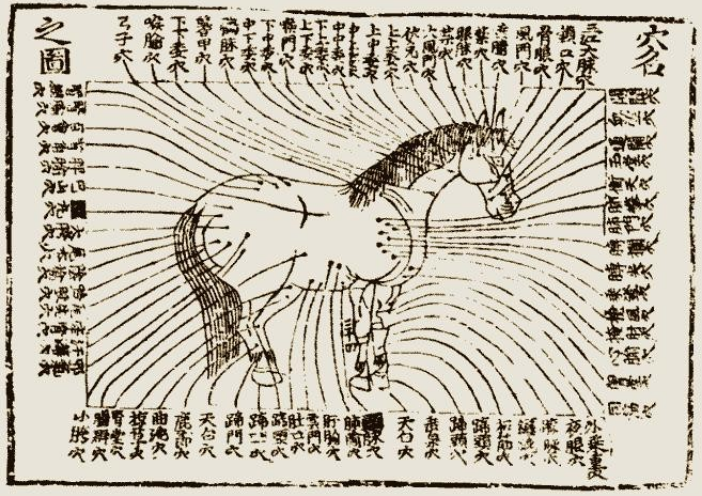
The diagnosis is therefore carried out and refined through a three-faceted prism:
The combined use of all these techniques enhances their effectiveness for maximum results. The goal is to offer horses integrative medicine.
That said, there is no such thing as a standard consultation. Each horse guides me toward its needs, which I limit myself to so as not to disrupt the existing balance or dynamics. It is a matter of being succinct and precise in the choice of information given to the organism and the technique(s) used.
Thus, the choice of treatment method depends on a precise individualized diagnosis and in-depth knowledge of therapeutic techniques, crowned by continuously nurtured and enriched experience.
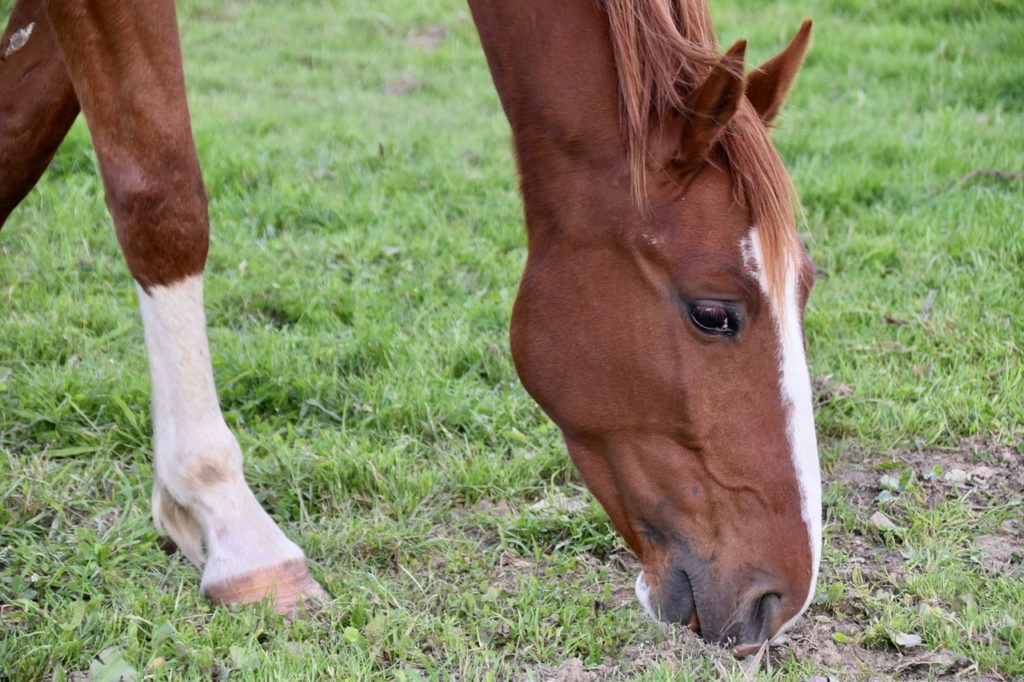
Puccini is a 9-year-old French saddle horse, chestnut with three beautiful white markings, two on the front legs and one on the hind leg. He was worked regularly until the start of lockdown—he is an eventing horse . Then he spent six weeks in the pasture and had lunging sessions in a sand arena. His owner was unable to visit him from March 16 to May1. Since returning to work, Puccini has not been lame or irregular, but his shoulder movement seems less fluid, especially on the right side. When jumping, he no longer clears the withers as well. Palpation reveals limited mobility in the withers and areas of tension in the triceps brachii on both sides.
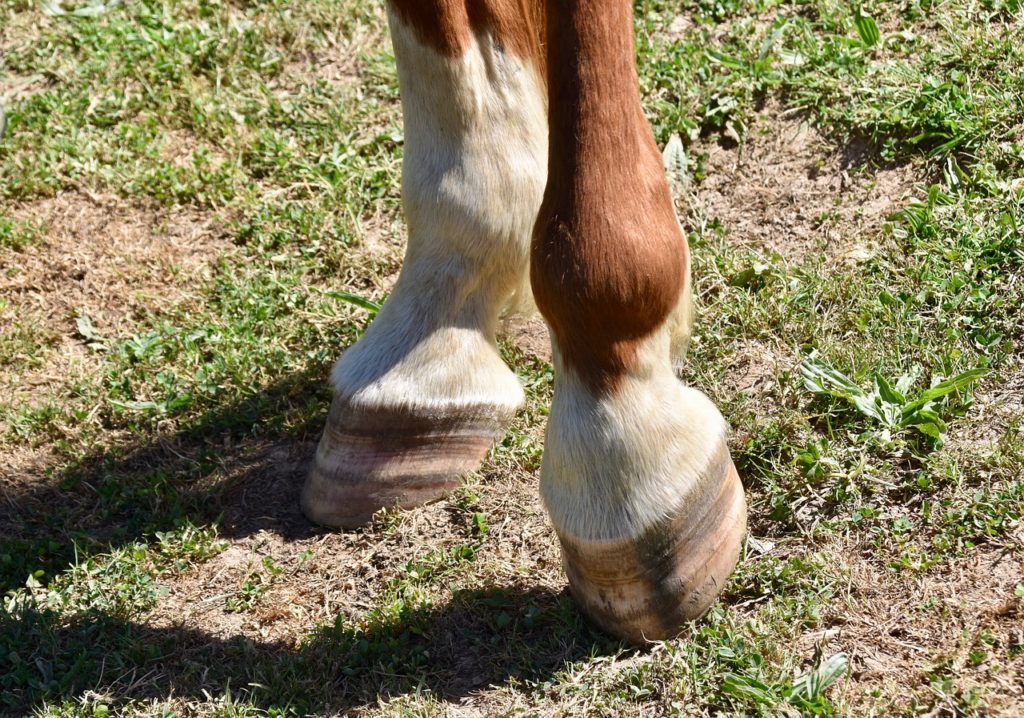
Looking at his feet, we can see that there have been cracks in the wall just above the shoes and that the feet have been trimmed quite short. There is no abnormal sensitivity or heat in the hooves, no digital pulse or congestion. However, his white feet are more sensitive to the pinch test than the pigmented foot. The owner confirms that Puccini is more hesitant on stony ground. He is also shod with plates during competitions. Palpation in acupuncture reveals roughly symmetrical blockages on the three lateral meridians of the foreleg (Large Intestine, Triple Heater, especially on the right, and Small Intestine on both sides). The osteopathic diagnosis is a fixation of the 4th and 5th thoracic vertebrae (withers) and the right shoulder.
Feet.
Puccini, like all the horses in the stable, had his shoes removed when he was put out to pasture at the start of lockdown. He was then re-shod at the end of April in preparation for returning to work. During the weeks he spent barefoot, the ground was dry. His fragile, brittle white hooves left the farrier with little horn to work with for the final shoeing.
Puccini may have suffered from his bare feet for several weeks and perhaps from a slightly tight shoe during the first few days. When his owner returned in early May, Puccini's feet were no longer sore. However, the discomfort in his feet caused enough muscle tension to fix a couple of thoracic vertebrae and a shoulder.
Acupuncture needles and osteopathic manipulation restored Puccini's normal locomotion. The owner is now careful to stretch his horse's shoulders regularly while waiting for the next shoeing, when he will put on plates.
To perform this shoulder stretch, stand facing the front leg you are going to mobilize. It is very important to look towards the rear of the horse. Then, take hold of the hoof and extend your leg. Be careful to remain parallel to the horse's longitudinal axis without lifting the hoof too far off the ground. The shoulder should be lowered in a cranial movement. This movement can be performed before loosening up. It allows the scapula to be freed from the saddle area and wedged "in place" behind the withers. It can also be performed after work to release tension in the triceps brachii.
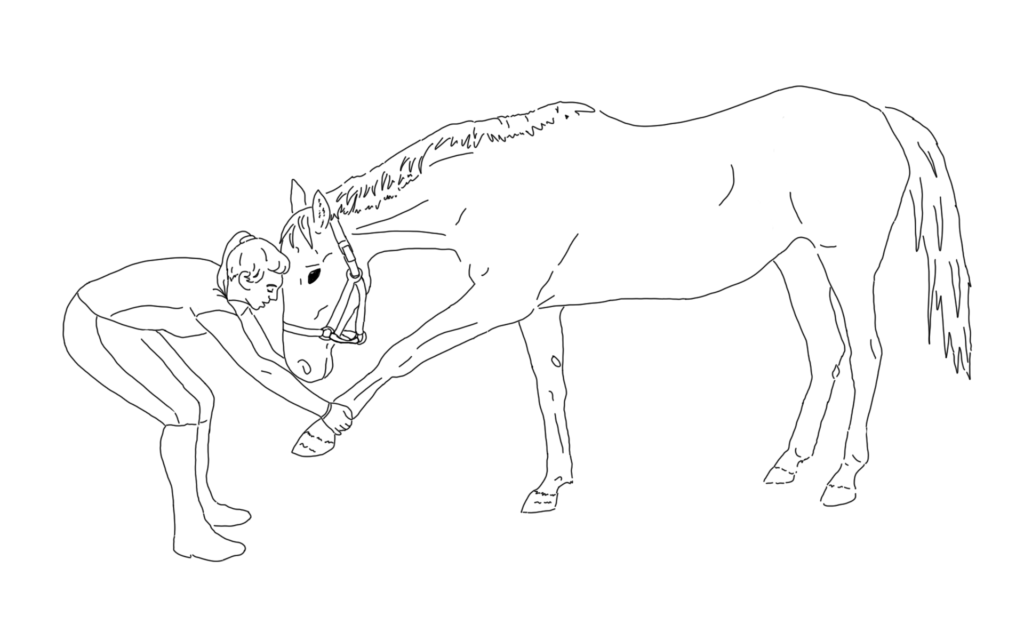
A horse that experiences constant or intermittent but regular discomfort in one or both front legs will eventually develop high muscle tension as a result of adopting pain-relieving postures and gaits. As in Puccini's case, this tension will lead to osteopathic fixations requiring external intervention.
The Seaver can help riders objectively measure a reduction in the mobility of a horse's shoulders during the same type of work under the same ground conditions. A horse that is "tight in the front" will find it more difficult to extend its forelegs and raise its withers, thereby reducing its bounce and the amplitude of its vertical movement.
The tool developed by Seaver compares bounce over the course of sessions and studies trot symmetry. If it is not optimal and progressive, this can reveal a mobility defect in the horse. That said, it should be borne in mind that rebound can vary depending on the type of work (in a round and low attitude, the rebound values will be different from those of collected work) and depending on the terrain (deep terrain results in low rebound, while soft or hard terrain results in greater rebound). This objectification of a locomotion defect, carried out by comparing Seaver data over several sessions under the same conditions, allows犀利士 s will make it possible to anticipate the "breakpoint." In other words, to avoid the moment when the overworked tissue breaks down and enters the clinical phase, revealed by lameness.